






No matter what stage your agency is at, online reviews aren't just a reputation play — they're a business development strategy.
There's a question insurance agents often ask when someone suggests they invest time in collecting online reviews: "Do my clients really care about that?"
The answer, backed by data and the psychology of high-stakes decision-making, is a firm yes. 97% of consumers read online reviews for local businesses, and in an industry built entirely on trust, what strangers say about you online has become the modern equivalent of a neighbor's recommendation.
But here's what most articles on reputation management miss: the reason reviews matter changes depending on where your agency is on its growth journey. A solo agent just getting started needs reviews for a completely different reason than an established shop with five producers trying to scale.
This article breaks down exactly why reviews matter — and which reviews to prioritize — across four distinct stages of insurance agency growth.
Before we get into growth stages, let's understand why reviews carry more weight in insurance than in almost any other service category.
When someone buys insurance, they're not buying a coffee. They're trusting you with something they hope they never need — and if they do need it, the stakes couldn't be higher. A claim denied, a coverage gap, a phone call that goes unanswered at the worst moment: these aren't minor inconveniences. There's a financial crisis.
That's what makes the review-reading behavior in insurance so pronounced. 88% of consumers trust online reviews as much as personal recommendations, and 57% of consumers won't use a business with fewer than 4 stars. Insurance consumers aren't browsing casually. They're doing due diligence before handing over their financial security.
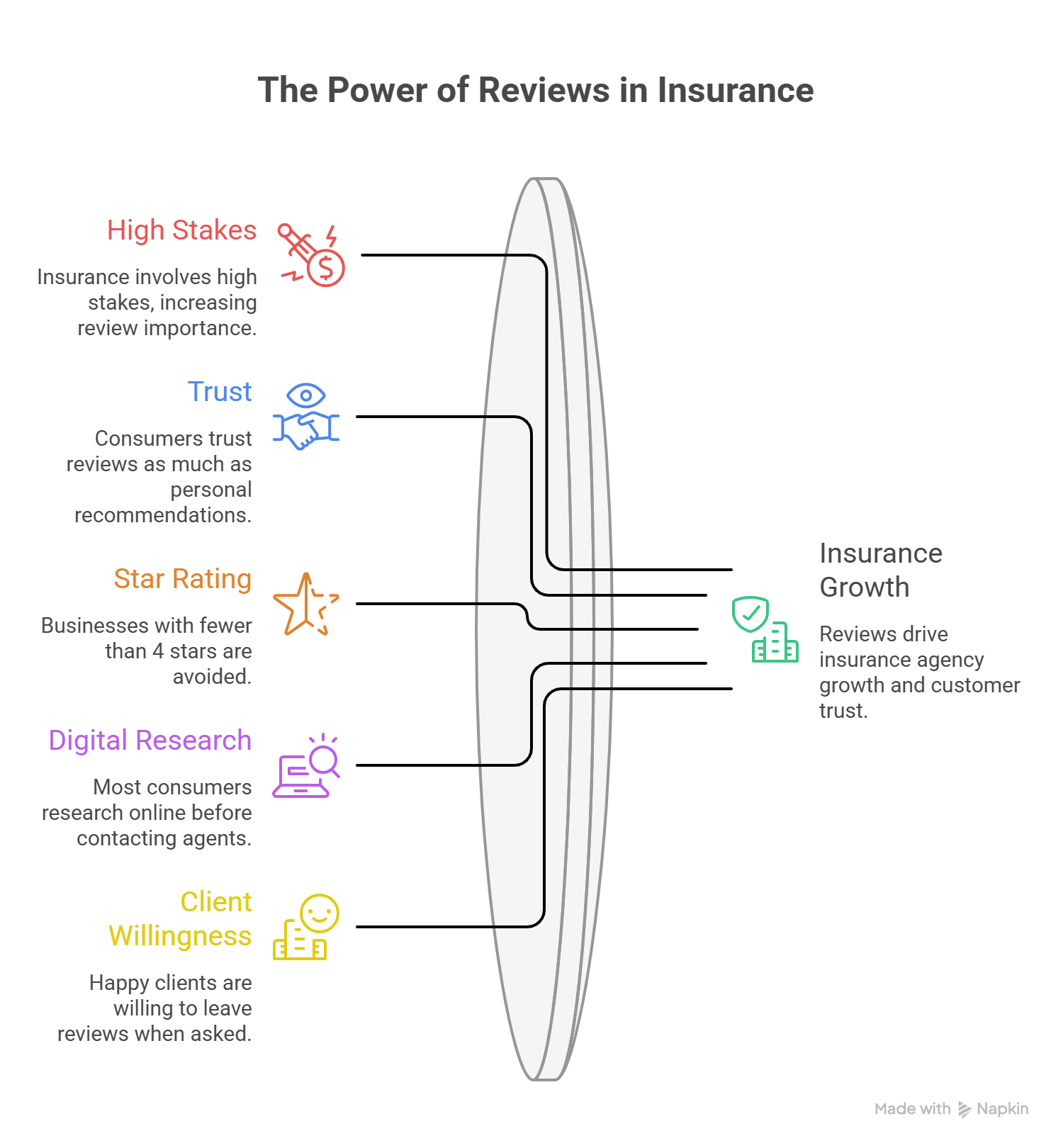
And the digital research habit is deeply ingrained: nearly 7 in 10 consumers search online before booking a meeting with an insurance agent. That means the review profile they find — or don't find — is often what determines whether they ever call you at all.
The good news: most happy clients are willing to leave a review. You just have to ask.
Who this is: A solo agent within the first 12–24 months. You've got your license, maybe a handful of clients, and you're grinding to build a book of business in a market that has no idea who you are. You're competing against agencies with years of community ties, carrier tenure, and dozens of reviews already posted.
The core challenge: Social proof is the great equalizer, and you have none.
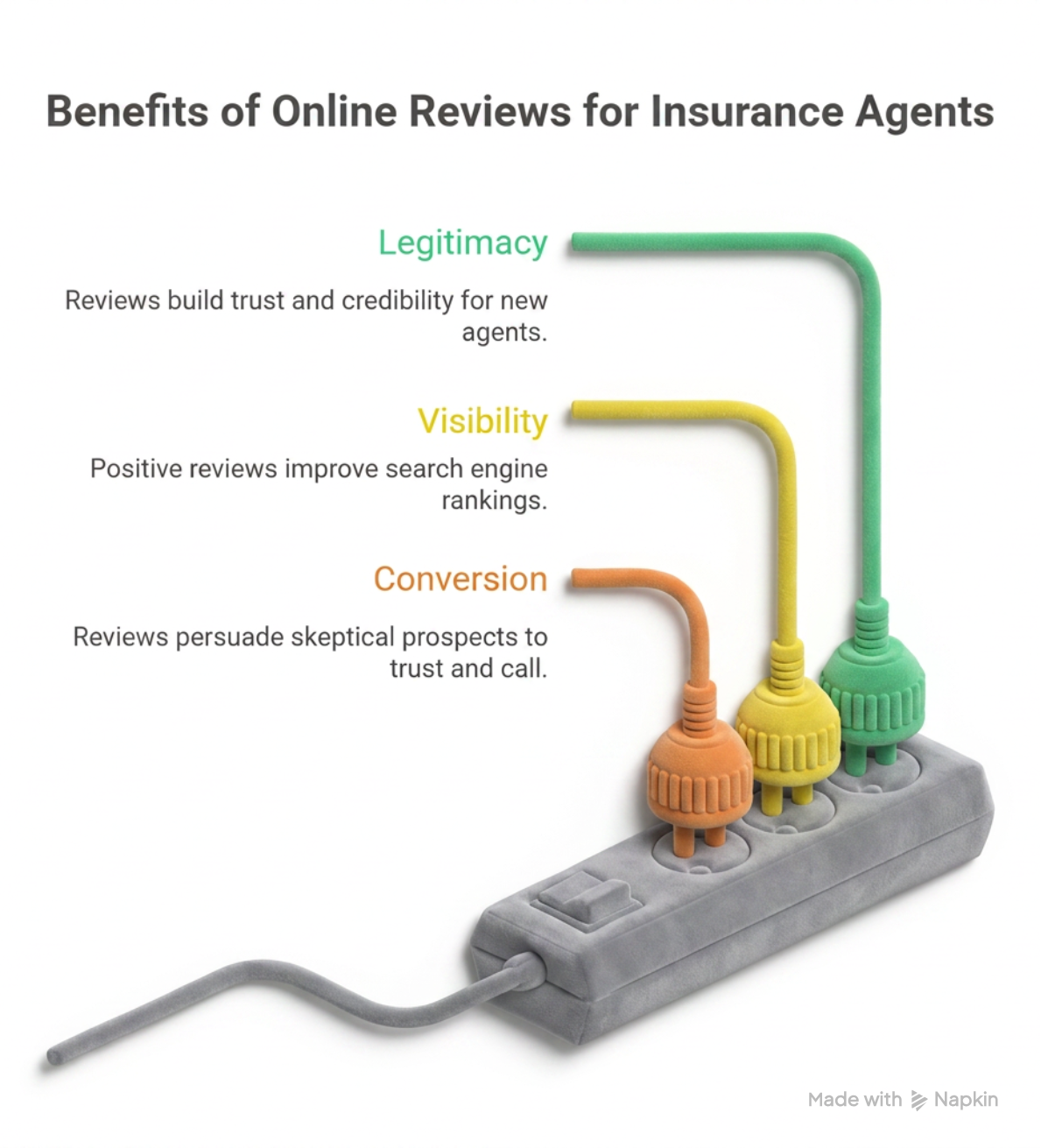
Psychology has a useful concept here: the availability heuristic. People judge the likelihood of a good outcome based on how easily examples come to mind. When a prospect searches for a local agent and sees one agency with 47 reviews averaging 4.8 stars and another with zero, the first option feels like the "obvious" choice — even if both agents are equally competent.
A handful of five-star reviews can instantly shape a prospect's impression before they've ever spoken to you. For a new agent, even five to ten genuine, detailed reviews can create enough perceived credibility to make prospects take you seriously.
Your first 90 days should include a deliberate ask to every client you onboard. After the policy is issued and while the relationship is warm, send a direct request. Not a generic "please review us" — a specific, personal message. Something like: "Working with you was a great experience. If you're willing, a Google review would mean the world to a new agency building its reputation here in [city]."
The zero-cost, highest-ROI marketing investment you can make at this stage is turning every single satisfied client into a visible testimonial.
Who this is: You've been at it for 2–5 years. You have a real book of business, maybe 300–600 policies. Referrals are coming in, but you're still losing prospects to competitors who are willing to undercut on price — and you know your service is better.
The core challenge: In a commodity industry, undifferentiated agents compete on price. Reviews are how you escape the price war.
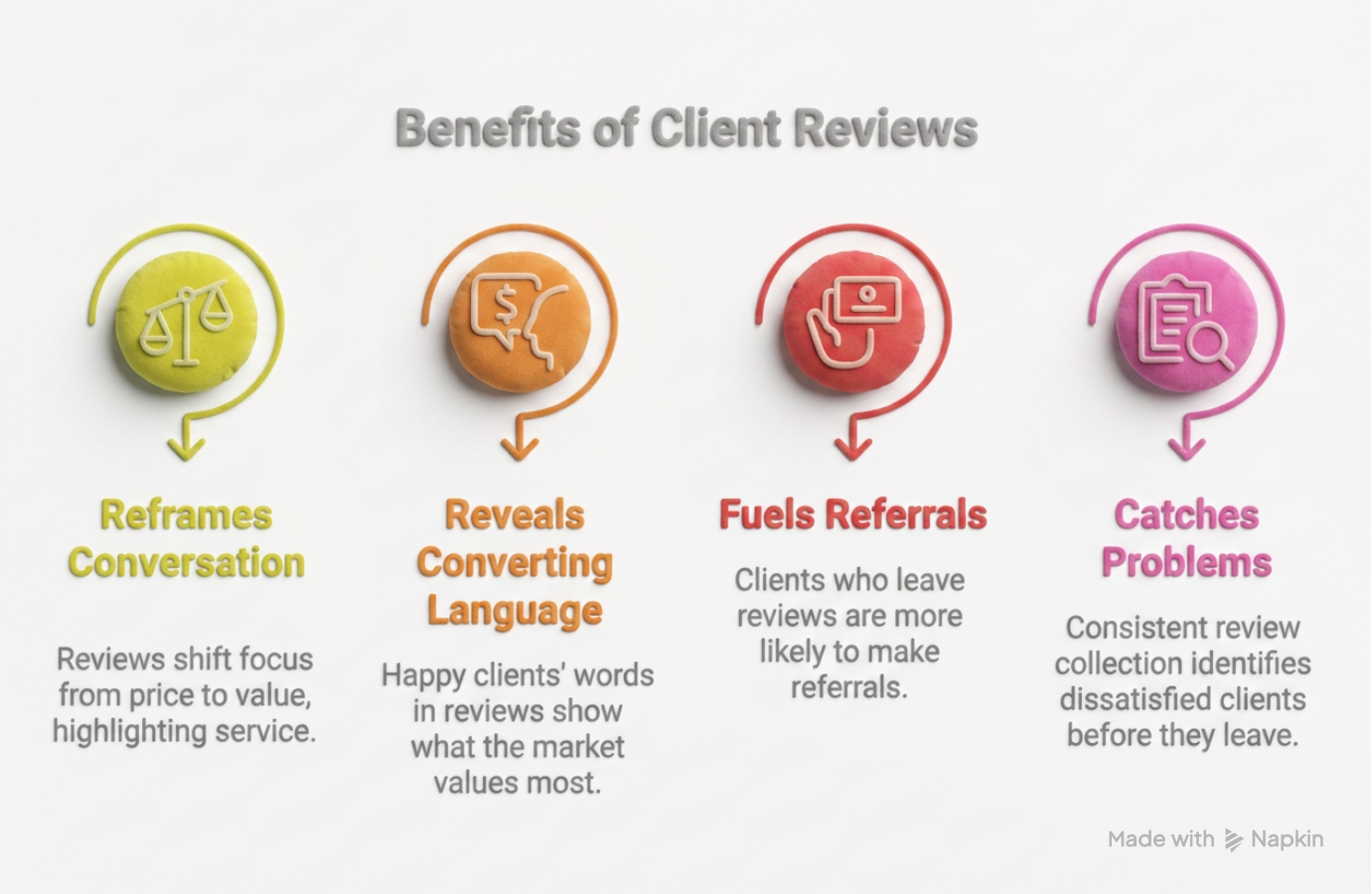
Here's the psychology: when people face a decision between two options where one is slightly more expensive but has dramatically stronger social proof, they often choose the more expensive option. This is because reviews reduce perceived risk — and in insurance, perceived risk is everything.
A prospect who finds your agency and reads 30 reviews where clients mention your responsiveness during claims, your follow-up calls, and your explanation of coverage options doesn't just see a price. They see evidence that you deliver what you promise. And that evidence is worth far more than $10 in monthly savings on a premium.
At this stage, the goal is consistency. You're no longer just collecting any reviews — you're building a profile with enough depth and recency that it tells a story about who you are and what clients can expect. Aim for a steady flow, not a burst.
Identify your "moments of delight" — the specific points in the client relationship where satisfaction peaks (successful claim, policy renewal where you found them a better rate, a helpful call explaining coverage confusion) — and build your ask strategy around those moments.
Who this is: You've grown beyond solo. You have producers, a service team, maybe multiple lines of business. You're thinking about hiring, about systems, about how to maintain the culture that got you here while expanding your reach.
The core challenge: Your reputation is no longer just about you. It's about everyone on your team — and that creates both opportunity and risk.
When you were a solo agent, every interaction with a client was yours. Now, a new producer's miscommunication, a rushed renewal call from an overwhelmed CSR, or a slow response on a claim can all become public reviews you didn't see coming. Meanwhile, the exceptional work your best people do is going unrecognized online.
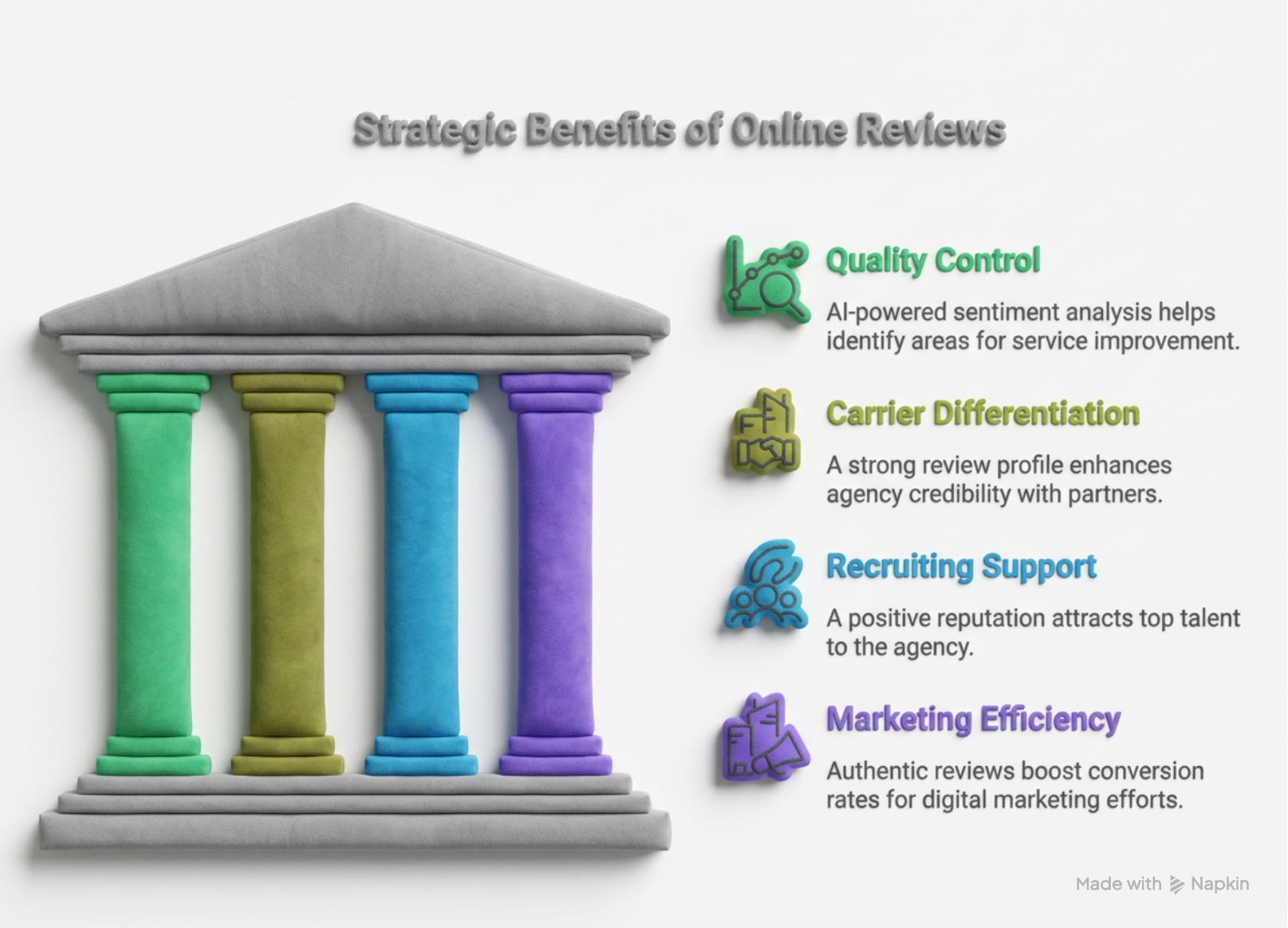
Build a system, not a habit. Solo agents can rely on personal memory and relationship management to ask for reviews. Growing agencies can't. You need automation: a consistent post-sale and post-renewal workflow that sends review requests without depending on any individual to remember to do it.
You also need centralization. Managing reviews across Google, Facebook, Yelp, and industry platforms manually is time-consuming and inconsistent. A central dashboard that aggregates reviews, alerts you to negative feedback, and lets you respond promptly is the difference between a managed reputation and a neglected one.
Who this is: You've made it. Multiple producers, a meaningful book of business, and a recognized name in your market. But the same size that gives you stability creates new vulnerabilities — and new competitive opportunities.
The core challenge: At this stage, your reputation can either be a strategic moat or a maintenance headache, depending on how actively you manage it.
A single negative review handled poorly can do disproportionate damage when you're a known entity. A competitor entering your market with a fresh brand and aggressive review strategy can erode your perceived dominance faster than you'd expect. And the operational complexity of a larger team makes reputation management harder to do manually.
But the opportunity is equally large. An established agency with hundreds of reviews, a consistent 4.8-star profile, and a visible pattern of professional engagement with every review has built something that a new competitor simply cannot buy or fake: earned trust at scale.
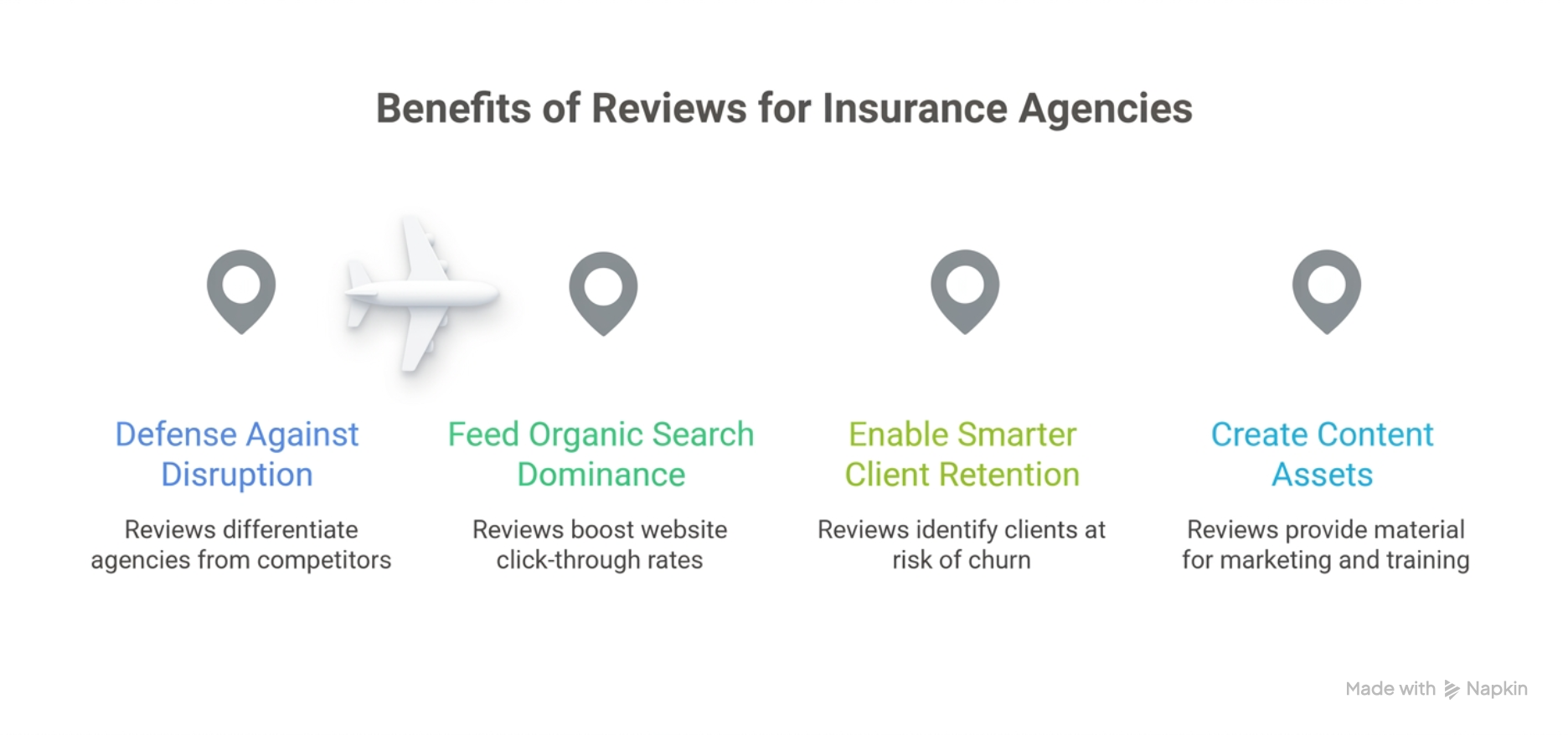
At this stage, reputation management needs to be a deliberate operational function — not something that happens when someone remembers to ask. The agencies that sustain competitive dominance through reviews treat ORM (Online Reputation Management) as a business system rather than a marketing task.
That means assigning ownership, using purpose-built tools, and treating your review data as a source of business intelligence — not just a score to monitor.
Across all four growth stages, a handful of psychological principles explain why reviews convert prospects into clients:
People look to others' behavior to decide what to do, especially in uncertain situations. Insurance is inherently uncertain — no one knows if their agent will come through until they need a claim paid. Reviews from real clients who've been through that experience are the most credible signal possible.
Behavioral economists have established that the pain of a bad outcome feels roughly twice as strong as the pleasure of a good one. For an insurance buyer, the fear of choosing the wrong agent and being left exposed or poorly served is powerful. Reviews reduce that fear. An agent with 80 reviews averaging 4.9 stars feels safe.
Volume matters. 10 reviews convey early credibility. 100 reviews convey established expertise. 500+ reviews convey market leadership. Each threshold shifts how prospects perceive your agency — before you say a word.
Clients who leave reviews have publicly committed to the idea that your agency is good. That commitment makes them more likely to stay, refer others, and be forgiving of occasional imperfections.
Across all four stages, the most common mistake is the same: waiting for reviews to happen rather than building a system to generate them consistently.
Happy clients don't leave reviews unprompted. Not because they don't care, but because life moves fast, and reviewing their insurance agent isn't top of mind after a smooth renewal. The agents and agencies with the strongest review profiles aren't the ones with the most delighted clients. They're the ones who make it easy and natural to share that delight.
A single automated workflow — triggered at the right moment in the client journey, personalized enough to feel human, simple enough to complete in two taps — outperforms years of hoping satisfied clients will think to Google you.
Whether you're a solo agent with 20 clients or a multi-producer agency with 2,000 policies, the principle is the same: your clients' words are your most valuable marketing asset, and most of them are willing to give you those words if you just ask.
The agencies that understand this and act on it systematically are the ones whose names show up first when a prospect in their market searches for help.
Stratosphere's ORM platform helps insurance agencies at every growth stage build, manage, and leverage their online reputation automatically. It's included free for qualifying agency partners. Learn how it works or Schedule a demo now.